
Methods
Detailed elucidation of experimental study set-up
Experimental Study
Describe the set-up and investigated variables
In total, 30 individuals were tested. Each individual was shown a set of items, presented either as pictures, words, or pictures and words combined. The amount of remembered words functioned as an indicator that reported how much the different types of presentation facilitate the capacity of human memory. The experimental design consisted of the following variables:
Design
| Variable | Measure |
|---|---|
| Dependent variable | Working memory corrisponding to the number or correctly/incorrectly/not remembered items |
| Independent variable | Presentation of items either as pictures, written words or annotated pictures |
| Control variables |
|
Our experiment was structured into three different types of presentations, namely presentation of words, pictures or pictures and words combined. Thus the design of our experiment consisted of three experimental groups whose results were compared to each other, following the design concept of Fred N. Kerlinger [2].
We chose a Between Subject Design, meaning each participant was part of one group assigned to one value of the active independent variable. Thus, everyone had to memorize the same items (control variable) and there was no learning effect as would occur if each participant had been presented with all three different values of the independent variable in a within subject design [3].
Procedure
We assigned the independent variable of the experiment in repeating order to make sure each independent variable value had a comparable sample size consisting of ten participants. Half of the participants were friends or acquaintances of ours, who could book timeslots in a schedule we provided. The other half were strangers we asked directly at the place where we conducted the experimental study to fill in the holes in our schedule and to get more participants. The experiment was conducted in closed group rooms at the Frescati Library and the DSV in Stockholm.
The participants were divided into 3 groups:
- First group was shown a set of written words
- Second group was shown a set of pictures which represent the same words
- Third group was shown the same pictures which were captioned with the words they represented
The items were shown sequentially, each for a set amount of time before they were removed. The exact amount of time was determined within our pilot study. All individuals were then asked to fill out a survey with the items they remembered from what has being shown to them (either pictures, words, or annotated pictures). They were allowed to write the items in their mother tongue if they didn't remember them in English. Furthermore, they were asked to describe how they remembered the words as an open question. They were subsequently asked if they imagined the items as a picture in their mind (visuospatial sketchpad) or used an inner voice to repeat them to themselves (phonological loop) to memorize the items.
Material
The items were presented as an automatic slideshow in Microsoft Office PowerPoint on a computer in an isolated room. This ensured reproducibility and that all pictures and words were represented in the same way and size and for an exact amount of time. A slide on the computer contained the items in the three different types of presentation (words, pictures and annotated pictures). The items were all presented one at a time in random order to ensure comparableness and to eliminate bias based on the order of the items.
A digital survey created in Google Forms was used to fill in the remembered items of the participants, to collect general information like age, gender, English level and whether they were currently enrolled at a university, as well as to inform participants about the ethics agreement and to confirm their consent to participation.
Pilot
Perform a pre-study for parameter configuration
We needed to calculate the exact arrangement and number of items in the used presentations. We did this in a pilot study as following:
- For the period of time for which the items were presented, we originally proposed a period of two seconds, referring to what Baddeley indicated of the capacity of the working memory [1]. A pilot study was conducted to test if this amount was appropriate, comparing participants' reactions and memory when items were presented for one second or two seconds. Participants in the two second pilot remembered 12, 13, 17, 20 and 21 items, while participants in the one second pilot remembered 9, 17, 16, 13 and 16 items. One participant in the one second pilot remarked without being prompted that they found the time the pictures were presented too short and referred to how they were unable to repeat the name of the item to themselves in only one second. Since we wanted to test for use of the phonological loop, we decided to stay with the two second exposure time to encourage the inner voice and to go along with Baddeley's theory.
- We needed to test the appropriate number of items to present to the participants. In the pilot study participants remembered between 9 and 21 items, though the highest number was treated as an outlier as the participant remarked on their exceptionally good memory. Since the surrounding circumstances of the pilot study were not as tightly controlled as the final study, we decided on 20 pictures for the experiment.
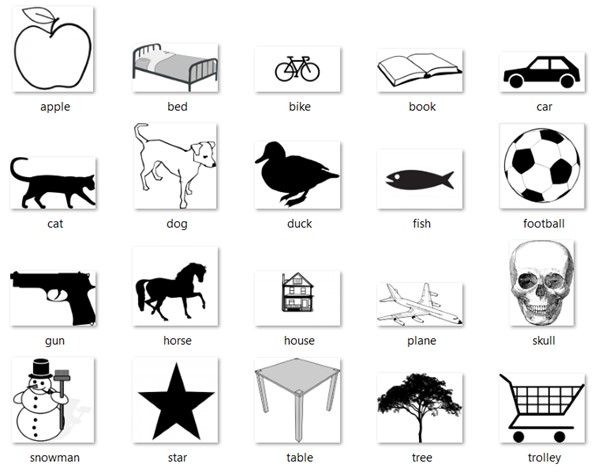
- To minimize ambiguities, a preselection of 28 pictures was used to test whether they were associated to one or more words by presenting the pictures to eleven different persons, who then had to name the objects in the pictures. All pictures that were associated with two or more different words by different people were eliminated in the process. We decided to mainly use words with one or two syllables as these words tended to be less ambiguous, and to ascertain that the name could be repeated in the two second expose period, thus enabling use of the phonological loop. The final 20 items used for the experiment are illustrated below.
Research ethics
Participants were informed that they were participating in an experimental study about memory at the beginning of the survey and “that they can withdraw from a study at any time without penalty” [4].
Consent was collected with a yes-or-no question after the explanation of the ethics agreement, in which we explained that the data we collect would be anonymized and there would be no way to link a response to an individual, relating to “Fairness, Responsibility, and Informed Consent” [4] and the “Clarification [...] to ensure that the client provides informed consent before and during intervention“ [5] (see Appendix A). No individual data was included on the report. Time stamps of when each response was recorded in the survey were deleted to comply with the “Adequate storage and handling of information and records, in any form, to ensure confidentiality, including taking reasonable safeguards to make data anonymous when appropriate”[5], and also, “every precaution must be taken to protect the privacy of the research subjects and the confidentiality of their personal information” [6]
After the test, participants were informed about the theory behind the experiment and what data we compared as referred to debriefing [4].
References
| Number | Source |
|---|---|
| [1] | Anderson, John R. (2015) Cognitive Psychology and Its Implications, Eighth Edition, New York, Worth Publishers |
| [2] | Kerlinger and Lee (2000) Foundations of behavioral research, Fourth Edition p.487, Wadsworth |
| [3] | Keren, Gideon & Lewis Charles (2014) A Handbook for Data Analysis in Behaviorial Sciences: Volume 1: Methodological Issues Volume 1: Statistical Issues, Psychology Press, p.257-272 |
| [4] | Kerlinger and Lee (2000) Foundations of behavioral research, Fourth Edition p.444-445, Wadsworth |
| [5] | EFPA (2005), 3.1 Respect for Person's Rights and Dignity, Revised by General Assembly in Granada, http://www.efpa.eu/ethics/meta-code-of-ethics-, accessed 01.10.2019 |
| [6] | Swedish Research Council (2017) Good Research Practice |
Get In Touch
You can reach me via email or LinkedIn message. I am excited to get in touch with you and I am always open for interesting projects or innovate ideas!